
OUR HISTORY
St John’s has been around for over 175 years in a number of incarnations. Below is a brief history of St John’s, which is covered in the book ‘Church Standing Tall’ by Scott Thompson. This book was published for the 150th anniversary of St John’s and is available to purchase.
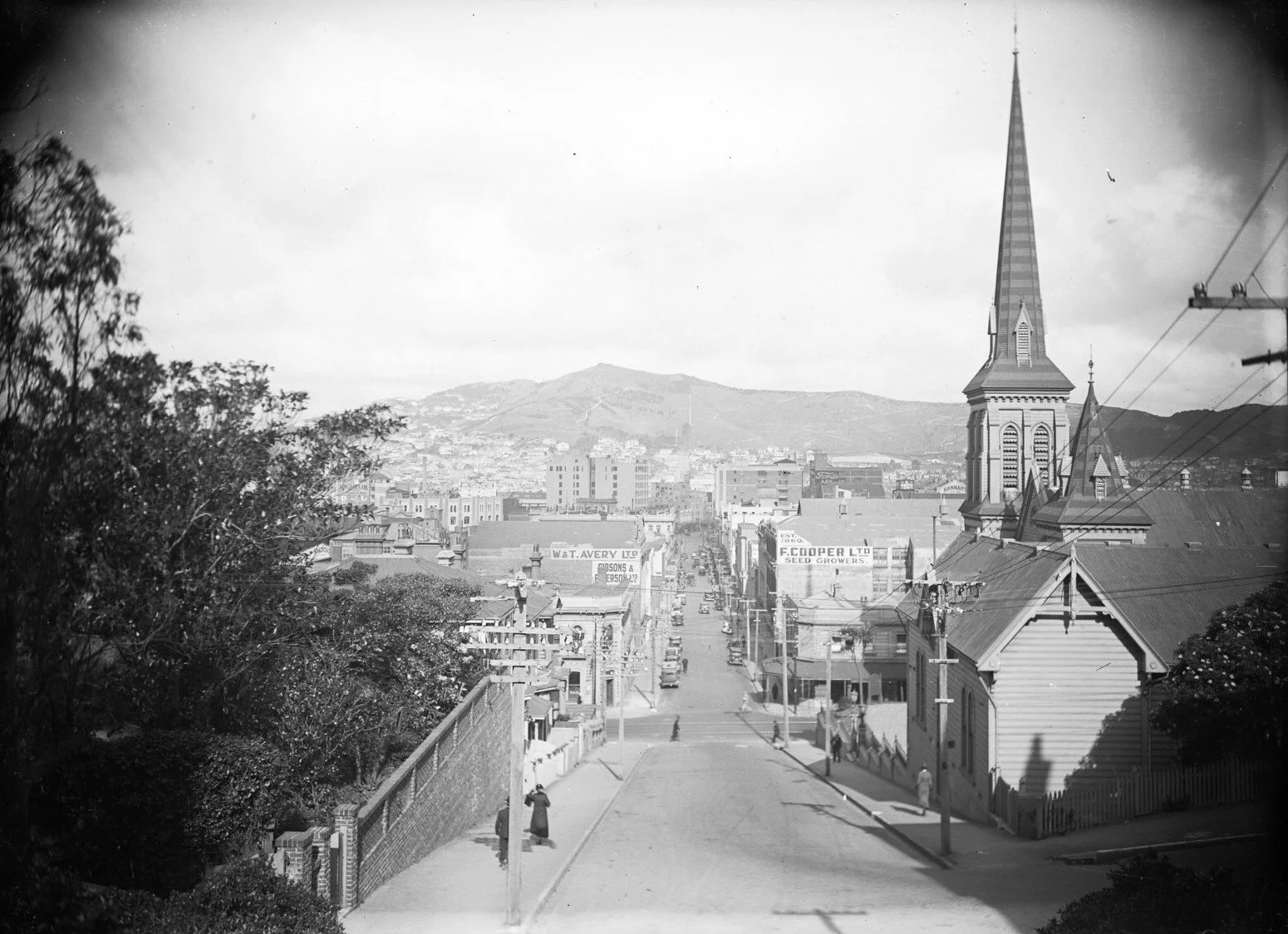
Soon after the arrival of the first settlers in Wellington in 1840, a group of Presbyterians built a church, St Andrews, on what is now Lambton Quay. In the early 1850s, the Reverend John Moir arrived from the Free Church of Scotland to minister to a group of Presbyterians at a new church on the corner of Willis and Dixon Streets. This became known as the Willis St Church. It was soon too small to accommodate the congregation, and after a number of changes it was finally demolished in 1874. Its replacement was completed in 1875 and was called St John’s.
Unfortunately, this church was destroyed by fire in 1884, along with the adjoining Sunday School. A larger church and schoolroom were then planned, incorporating the section occupied by William Spinks, a shopkeeper.
The present St John’s was designed by well-known architect Thomas Turnbull. He also designed the nearby St Peter’s Anglican Church, Wesley Methodist Church in Taranaki St, and later the General Assembly Library in Parliament grounds. The new Church was opened in 1885, with seating for 800, in a parish with 360 communicant members. By 1911 the parish had 700 communicant members, with attendance of 1,000 on most Sundays.
When it was established, the Church was very much on the edge of the colonial town, surrounded by mainly residential dwellings. With the expansion of the city over the decades, the Church is now in the commercial part of city. However, with the advent of apartment living, and the movement of people back into the city, this is changing once again.
Today many of those who worship at St John’s in the City come from outside the city centre. The closure of the Roseneath Church on Mt Victoria in the 1980s and uniting with Kelburn Parish in 1993 both added a new dimension to St John’s in the City. The completion of the site redevelopment in 1994, including the replacement of Troup House, the building of the St John’s Centre, and the addition of the MacKay Chapel to the Church, together with the increasing ethnic diversity within the parish, has seen St John’s change in many different ways.
During the Covid pandemic, we worshipped differently, using digital technologies to stay connected as a parish. We also were earthquake-strengthening the church during this unsettled time, but in August 2020, we reopened our doors for all.
Check out our historical resources for more information. If these don’t provide the information you are searching for, please get in touch with us.